Discover how AI agents — the next evolution of chatbots — are transforming work in 2026, handling complex tasks, automating workflows, and reshaping careers in the digital era.
What Are AI Chatbots vs. AI Agents?
Chatbots are AI systems that respond to simple questions and follow predefined paths when a user inputs text. They’re reactive, scripted, and limited in scope — basically question–answer machines.
AI agents, on the other hand, are autonomous, goal-driven AI systems that can plan, execute multi-step tasks, and connect to tools or platforms to complete work for you without constant prompts.
👉 Think of it as the difference between:
- Chatbot: “What’s my schedule today?”
- AI agent: Reads your emails, updates your calendar, schedules meetings, and sends confirmation emails on your behalf — all automatically.
Visual Overview
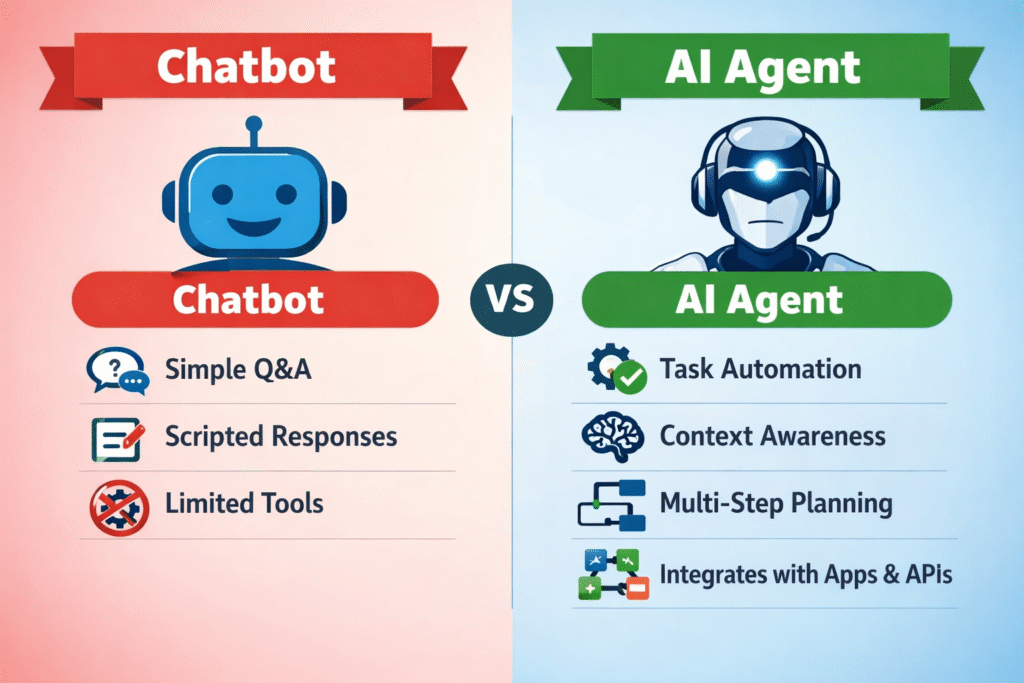
Here’s a helpful diagram comparing the two:
🚫 Chatbot
🔹 Simple Q&A
🔹 Scripted responses
🔹 Limited tool integration
✅ AI Agent
🔹 Autonomous task completion
🔹 Context awareness & memory
🔹 Integrates with apps, APIs, and workflows
🤖How AI Agents Are Already Changing Work (2026 Edition)
1. Knowledge & Office Work
AI agents can:
- Automate reports and data summaries
- Sort and prioritize your inbox
- Draft proposals, briefings, or client messages
Example: AI agents can screen resumes, schedule interviews, and track candidate progress without constant human oversight.
2. E-commerce & Customer Workflows
AI agents now:
- Manage customer queries end-to-end
- Handle refunds or rebookings
- Update inventory and pricing dynamically
This goes well beyond chatbots’ scripted FAQ replies.
👨💻 3. Software, DevOps & IT
Agents programmed with automation logic can:
- Trigger builds
- Debug routine issues
- Monitor systems
- Even deploy hotfixes with guardrails
This shifts developers toward designing AI workflows instead of writing repetitive code.
Why 2026 Is the Year AI Agents Matter
In 2026, agents aren’t just tools — they’re becoming digital workers that trigger actions, handle complex decisions, and coordinate across systems. Leading businesses are piloting or deploying agentic workflows in production environments.
However, this shift also brings security concerns: researchers note that major AI agents can be spoofed if proper protections aren’t in place, posing new cybersecurity risks.
Who Is Most Affected?
Jobs most impacted:
- Repetitive admin roles
- Basic customer support
- Junior analytical tasks
Jobs most resilient:
- Strategy & leadership
- Creativity & human-centered work
- Cross-cultural negotiation
- Ethics & decision oversight
AI agents augment rather than replace humans — but workers who don’t adapt risk being outpaced by those who do.
New Skill Shifts for 2026
| Old Focus | New Focus |
|---|---|
| Manual tasks | Designing AI workflows |
| Single actions | Goal setting & supervision |
| Script execution | Context understanding |
| Memory recall | Strategic judgment |
| Speed | Reliable outcomes |
The future worker will be a partner with AI — not someone doing repetitive work that AI can automate.
Real-World Example: AutoGPT
One early popular autonomous AI agent project was AutoGPT, an open-source agent built on GPT-4 that can break down goals into subtasks, plan, and act without repeated user commands — a true example of what agent-driven work can look like.
Conclusion: The AI Work Evolution
- Chatbots answer questions.
- AI agents do work.
In 2026, AI agents are redefining workflows across industries — automating complex operations, driving productivity, and transforming the nature of work. As AI becomes more integrated, professionals who learn to work with agents will have an edge in the job market of tomorrow.