Why websites in 2026 are evolving into an AI product and how this shift is changing design, marketing, and user experience.
Introduction
For decades, websites were static pages. Then they became interactive. Then dynamic.
Now in 2026, they are becoming intelligent.
The modern website is no longer just a digital brochure or a collection of pages. It is a system that understands users, adapts to their behavior, and actively helps them accomplish goals.
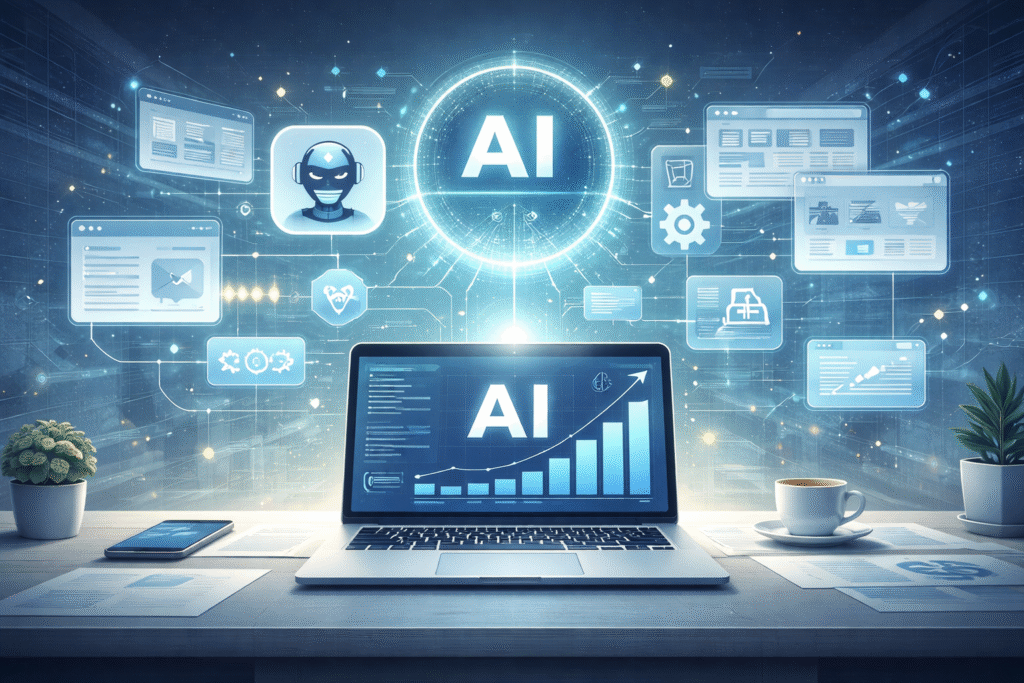
AI has quietly moved from being an add-on feature to becoming the core engine behind how websites function. Search, personalization, recommendations, customer support, analytics, and even design decisions are increasingly driven by machine intelligence.
This article explains why every website is turning into an AI product, what this means for founders, creators, and businesses, and how you can adapt to this shift.
From Static Pages to Intelligent Systems
Phase 1: Static Websites
Early websites simply displayed information. Content was fixed, identical for all visitors, and manually updated.
Phase 2: Dynamic Websites
With CMS platforms like WordPress and Blogger, content became easier to update. Websites could react to user input, but logic was still rule-based.
Phase 3: Data-Driven Websites
Analytics tools such as Google Analytics allowed site owners to track behavior, but not interpret or act on it autonomously.
Phase 4: AI-Powered Websites (2026)
Websites now:
- Personalize content automatically
- Predict user needs
- Generate responses and recommendations
- Optimize themselves over time
They are no longer pages — they are products.
What Does “AI Product” Mean?
An AI product is a system that:
- Learns from data
- Adapts behavior over time
- Makes decisions or recommendations
- Improves itself with feedback
When a website uses AI to guide user experience, content, or conversion, it becomes an AI product.
Examples:
- A blog that personalizes article recommendations per reader (like Medium).
- A SaaS website that adjusts onboarding based on user behavior (like Notion).
- An e-commerce site that dynamically changes offers and layout (like Shopify).
Where AI Is Already Embedded
Search and Navigation
Modern internal search uses semantic understanding instead of keywords. Tools like Algolia and AI-powered search APIs interpret intent, not just text.
Personalization
Platforms like Dynamic Yield personalize content and layout per visitor.
Customer Support
AI chat tools such as Intercom and Zendesk AI now handle most support interactions.
Content Creation
Content platforms and marketers use tools like ChatGPT, Jasper, and Copy.ai to generate and optimize content.
Conversion Optimization
AI-based testing tools like VWO and Optimizely continuously test layouts and messaging.
Why This Shift Is Inevitable
1. User Expectations Have Changed
Users expect:
- Instant answers
- Personalized experiences
- Context-aware interfaces
Static websites feel outdated.
2. Competition Is Algorithmic
Your competitors are not just businesses — they are algorithms that optimize faster than humans.
3. Economics Favor Automation
AI lowers cost, increases speed, and improves performance simultaneously.
4. Complexity Exceeds Human Capacity
There is too much data for manual optimization.
Traditional Website vs AI Website
| Aspect | Traditional Website | AI Website |
|---|---|---|
| Content | Fixed | Adaptive |
| UX | Same for everyone | Personalized |
| Optimization | Manual | Continuous |
| Support | Human-based | AI-first |
| Decision-making | Static rules | Learned behavior |
What This Means for Founders and Creators
Your website is no longer:
- Just a brand asset
- Just a marketing channel
- Just a content platform
It is:
- A product
- A system
- A living interface
You now design:
- Feedback loops
- Learning systems
- Data flows
- Adaptive experiences
Not just pages.
How to Adapt
1. Think in Systems
Design workflows, not layouts.
2. Collect Better Signals
Use tools like Hotjar or PostHog to understand behavior.
3. Embed Intelligence Gradually
Start with search, recommendations, or support.
4. Keep Human Oversight
AI optimizes; humans define purpose.
Risks and Considerations
- Data privacy and compliance (GDPR, consent)
- Over-automation reducing authenticity
- Algorithmic bias
- Dependency on platforms
Use AI to improve trust, not replace it.
Conclusion
Websites are no longer static destinations. They are evolving into adaptive, intelligent systems that learn, respond, and improve.
The question is not whether your website will become an AI product — but whether you will design it intentionally or let it evolve by accident.
Those who understand this shift early will build faster, smarter, and more resilient digital businesses.